Life on Mars
I recently read an exciting scientific paper about the discovery of ferrihydrite on Mars. Ferrihydrite is essentially a form of rust. The reason Mars is often referred to as the ‘Red Planet’ is because much of its surface is layered in reddish iron-oxides, essentially rust. So why is ferrihydrite on Mars such a big deal? Because, you morons, it might be a sign of life!!
Okay, sorry for that little(?) outburst. Clearly, I should probably back up a little, or maybe a lot, or maybe so far, no one will possibly read to the end of this blog, or perhaps I already lost you at…morons!
So rust (I’ll often refer to them as iron oxides) comes in several different mineral forms, there’s ferrihydrite, goethite, lepidochrocite, magnetite, maghemite, and hematite, among others. The important thing about these different forms of mineral rust is that they differ in how much they can resist change to their structure. Ferrihydrite is the least stable, i.e. mostly easily changed, while hematite is the most resistant to change. Some of the oldest rocks on Earth are hematite, but on Earth we don’t find old really old ferrihydrite. In another example, iron oxides are used as essential pigments in paint to give a range of red to yellow colors. Ferrihydrite is not used as a paint pigment because after something was painted with a ferrihydrite dyed paint it would change color as the ferrihydrite aged within years to decades. Instead iron minerals like hematite and goethite are used because they won’t change color.
Now for a second aside: iron and life. Biology has taken advantage of, and in some sense is wholly dependent upon iron’s atomic capacity to readily either pick-up/accept or give-up/donate an electron in the range of temperatures and pressures that water is liquid. Iron is the core atom for hemoglobin, and related molecules that transport oxygen throughout the bodies of animals. The enzymes in our cell membranes that process our food to produce ATP, the primary source of cellular energy, are elaborately designed to utilize iron atoms to carry out these reactions by moving electrons around. The photosynthetic apparatus of plants uses atoms of iron to convert sunlight to the energy that powers growth. Nitrogenase, the enzyme that allows certain microbes to convert nitrogen gas into ammonia and other forms of nitrogen that are required by all of life has an iron atom or two at its core. Conveniently, iron is also abundant. When stars implode into supernova, the resulting immense pressures and temperatures cause their central atoms, hydrogen and helium, to fuse together to make larger atoms like carbon and nitrogen. Interestedly, the largest atom this fusion process can produce is iron, all the higher atomic number elements are formed by more rare fission-type processes. So that’s a reason iron is abundant on Earth, on Mars, and presumably on all rocky planets.
Aside number 3: Iron and microbes. When an iron atom donates an electron to oxygen, it creates a tiny spark of energy. This is also when the iron atom changes from the reduced ferrous state (soluble in water) to the oxidized ferric state that produces a solid mineral iron oxide, or rust. This is referred to as oxidation. The iron-oxidizing microbes I study developed the trick of capturing this tiny spark to power their cell growth. And by tiny, I mean just about the smallest spark of energy that a cell can use for life. An iron atom packs somewhere between 1/50th and 1/100th the amount of energy of a glucose molecule. Iron-oxidizing bacteria, as we refer to them, are another beautiful example of how life has evolved to take any little scrap of energy it can use and develop an entire ecosystem.
If eeking out a living on such a poor energy source weren’t enough, iron-oxidizing bacteria face two additional problems. First, in the presence of oxygen, (ferrous) iron will spontaneously donate its electron to oxygen if it is present. This is why an iron bar or bare metal on a car will rust, especially if it gets wet. This means the iron-oxidizing microbe must capture the electron from an iron atom before it spontaneously reacts with oxygen. In general, the easiest way for iron-oxidizing bacteria to do this is to simply live in places where there is some, but not very much oxygen. For the majority of Earth history, oxygen was either very rare (until around 2.4 billion years ago), or modestly present (until around 600 million years ago). This latter period is when we think iron oxidizing bacteria evolved on Earth. On modern Earth with a well oxygenated atmosphere, low oxygen habitats are still pretty common, wetlands, underground aquifers, or hydrothermal vents in the ocean are some examples, and these are where we find these bacteria today.
The second problem for these bacteria is that because the spark of energy from oxidizing iron is tiny, even a small cell requires a lot iron sparks to survive, meaning it makes plenty of rust. If you are producing a lot of rust to live, how do you avoid filling your cell and/or encasing yourself in a rusty tomb of your own making within a few seconds? Again, these humble microbes have come up with elegant solutions. First, in a sense they have turned their biochemistry inside out. Most bacteria, as well as all animal and plant cells, keep all their energy yielding reactions inside the cell, since that’s most efficient; however, to avoid the rust problem, iron-oxidizing bacteria do their energy yielding reaction, iron-oxidation, outside the cell, and somehow transfer the energy inside the cell. Based on physics, we assume that this transfer process requires the equivalent of a biological wire to conduct an electron the whopping distance of a few 10’s of nanometers(!) from outside the cell to inside the cell where ATP is made. We have some hazy ideas on the biochemical mechanisms of how the cells pull off this feat, but many details remain to be figured out. The second related issue is that even if you turn your biochemistry inside out and make the rust outside the cell, it could still stick to the cell surface and cause entombment. Iron-oxidizing bacteria have come up with several clever ways of preventing this by producing long filaments, such as tubular sheaths or extracellular stalks that control how the rust is formed outside the cells. These structures both save the cells from entombment while providing the cell a way to stay close to it’s energy source and even move through its environment. Guess what the primary mineral is in these elaborate structures iron-oxidizing bacteria produce? That’s right ferrihydrite!
So, can we finally get back to why this discovery of ferrihydrite on Mars is exciting? No, wait we need yet another aside. We’ve been investigating Mars for years, so why it is ferrihydrite only being reported now? The two Martian rovers Spirit and Opportunity that landed in 2004 had some capacity to analyze minerals on the Martian surface, and there are also orbiting satellites that can study its mineral composition. The newest rover, Perseverance, has the most advanced capacities for mineral analysis. Perseverance has steadily been collecting more and more data about minerals on Mars. In fact, one of its recent discoveries was about olivine, another iron mineral, and one that NASA made a big deal about as a possible signature for life, although personally, I think ferrihydrite is an even better signal. The problem with detecting ferrihydrite gets back to the stability issue I mentioned above. The less stable a mineral, the harder it is for space-based analytical instruments to reliably detect it. Other analyses of Martian dust and dirt have reported ‘amorphous iron oxides’, noted they are common and can be quite abundant, and then focused on things like olivine and hematite. The group that published this paper that got me excited really dove deep into analyzing the signal from this ‘amorphous iron oxide’ and came to the conclusion it is ferrihydrite.
Now back to life! We know the iron oxides produced by microbes living on iron is ferrihydrite, but it’s not a pure iron oxide, the microbes contribute some organic matter. We don’t know the precise molecular details of this organic matter (certainly some of it is polysaccharide). What we have found is that the natural ferrihydrite in samples produced by iron-oxidizing bacteria do remain remarkably stable. They don’t easily turn into the more stable iron minerals, like goethite or hematite, whereas if we synthesize ferrihydrite in the laboratory it does pretty quickly change (weeks/months/years) to these more stable minerals. From the microbes’ perspective, it is useful for the ferrihydrite to remain unstable, since it is more easily converted back to ferrous iron, often by other microbes. It is common for that ferrous iron to then become available for the iron-oxidizing bacteria to use again for energy and growth. Clever little buggers.
This is important in relation to Mars, because one of the key questions about finding ferrihydrite on Mars is: Why is it still ferrihydrite billions of years after it was formed? From what we can tell, the Martian surface has been very cold and dry for at least three billion years. These conditions would help stabilize ferrihydrite, and if microbes were responsible for the producing a more stable form of ferrihydrite in the first place, that would help even more!
The even bigger conundrum is how did the ferrihydrite form on Mars in the first place? There are nonbiological ways for ferrihydrite to form based on reactions of iron with sunlight (photochemistry in scientific parlance) that are a definite possibility, and there are purely geological activities that can cause its formation, although these are hard to understand, and, in my opinion, seem most unlikely. The ferrihydrite paper spends a fair amount of time discussing these nonbiological pathways; meanwhile mostly avoiding the 800,000 gram microbe in the room, iron bacteria!! (I understand why the authors downplayed the likelihood of the ferrihdydrite being biogenic; claiming you've found proof for life on Mars is really extraordinary and will require extraordinary evidence, well beyond what this single study achieved).
Of course, as a microbiologist I prefer life being involved in producing the ferrihydrite on Mars. In the case for life, I am totally biased in believing the same bacteria that are responsible for the vast majority of biogenic ferrihydrite production on Earth, and the one’s I’ve spent a career studying must be the ones that are responsible for being Martian Microbes! However, as an objective observer, I have to admit that there is another group of microbes on Earth that are known to grow photosynthetically, and instead of producing oxygen as a product of photosynthesis, they produce ferrihydrite! It’s generally accepted that these bacteria were some of the first photosynthetic organisms on Earth, and would have thrived before cyanobacteria came along and invented oxygenic photosynthesis that produces the oxygen we breath in our atmosphere today. So, could these bacteria have thrived on a cold, wet, dimly lit Mars three billion years ago? Seems possible. Could there have been enough traces of oxygen around that the iron oxidizing bacteria that are most prevalent on Earth today could have thrived on Mars? Also possible! Suppose bacteria did exist on Mars that are responsible for producing the ferrihydrite we detect now, could they have evolved completely independently of those that inhabit Earth? Perhaps possible! Or could they be responsible for seeding life on Earth? Once more, possible! Or originally come from Earth? Yet again, possible! Could the abiological explanation(s) for ferrihydrite on Mars be correct? Grudgingly, possible!
Is it conceivable that in today’s world the United States could choose to forego 2 or 3 days of munitions expenditure on yet another baseless war of opportunity, and instead spend the money on returning samples from Mars to answer these questions? Now we are in the realm of the impossible! Does the shocking word I began this piece with now seem less shocking?
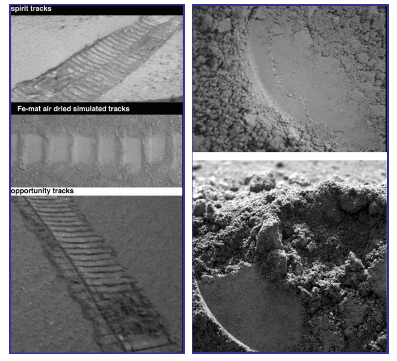
When the Opportunity and Spirit rovers landed on Mars in 2004, I had funding from NASA to study iron-oxidizing bacteria as possible biosignatures for life on other planets, and so was excited to follow the fate of those rovers closely. Some of the first amazing images they sent back were of their wheel tracks on the Martian surface and the imprint one of the instruments made when pressed into the Martian regolith (dirt). These were remarked on at the time as being unusual, i.e. different from what compaction patterns would look like from one of Earth's deserts. I diligently acquired microbial iron mat samples from nearby iron sites and dried them in different ways, and then tried to reproduce the compaction patterns with startingly realistic results. I used other iron minerals, including ferrihydrite I synthesized in the lab, but none of them matched patterns as well as the biologically produced iron oxides (ferrihydrite). I presented these at some scientific meetings at the time, and people told me I was an outstanding microbiologist, but also told me I didn’t know anything about mineralogy, or the surface of Mars. All three things are true!
Subsequent work on the mineralogy of the Martian surface led me to believe that other minerals beside ferrihydrite were dominant, at least as I hazily understood it. This is why the ferrihydrite paper was so exciting to me; maybe my ignorance wasn’t so far off after all. Indeed, I’ve sent some of the same samples (some of them now over 30 years old!) I used in my experiment to the author of the Mars ferrihydrite paper to see if they are of any use in further analyzing the mineralogical information we currently have from Mars. Unfortunately, if there is a definitive answer, it will almost certainly require bringing Martian samples back to Earth for really detailed analysis. Still, I am now quite sure my odds of being correct about the iron oxides on Mars being made by microbes are better than my odds (or my wife's odds) of winning the next SuperDuper Powerball lottery!

Comments